New Climate Resilience Project Targets Risks Facing 560 Million People Along India’s Coast
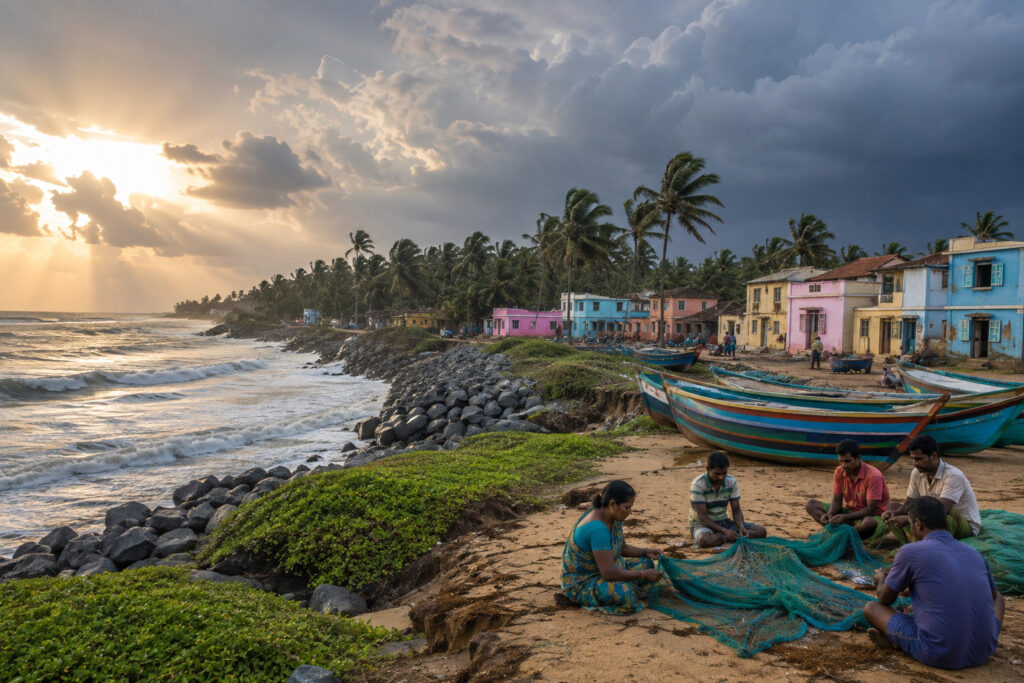
A new community-led climate resilience initiative will use artificial intelligence, open-source data and local knowledge to help vulnerable coastal regions in India prepare for rising seas, erosion, flooding and increasingly severe weather.
Lloyd’s Register Foundation has announced funding for the Coastal & Ocean Resilience Data Collaborative, which will initially focus on Odisha, Tamil Nadu and Kerala.
Led by India-based research lab CivicDataLab, the initiative aims to tackle a significant obstacle facing climate adaptation efforts: important information about climate risks, infrastructure, communities and public finances is frequently fragmented across different organisations.
The project will create an open-source platform bringing together datasets covering weather, oceanography, coastal topography, environmental conditions, socio-economic indicators and public finance.
Artificial intelligence and machine learning will then be used to analyse the information and turn it into insights that local authorities and other organisations can use when deciding where climate adaptation measures and investment are most urgently required.
India’s Coast Faces Growing Climate Pressure
The potential impact is considerable.
India represents less than 0.25% of the world’s total coastline, but around a tenth of the world’s coastal population lives along the country’s shores.
Approximately 560 million people live in India’s coastal areas, with industries including fishing, aquaculture, tourism and trade supporting communities and regional economies.
These communities are increasingly having to contend with the consequences of climate change alongside existing environmental pressures.
According to CivicDataLab, around 34% of India’s coastline is experiencing erosion, while cyclones, flooding and sea-level rise present additional threats to communities and vital infrastructure.
Gaurav Godhwani, Founder and CEO, CivicDataLab, said: “India’s coastline is more than a boundary between land and sea. It is home to millions of people, critical ports and infrastructure, rich ecosystems, and some of the country’s most important economic activity. Yet this coastline is under growing pressure. Around 34% of India’s coastline is experiencing erosion, while coastal communities are increasingly exposed to cyclones, flooding, rising sea levels and other climate-related hazards.
“However, the data needed to understand and protect India’s coastline often remains fragmented and locked among various stakeholders. Through the Coastal & Ocean Resilience Data Collaborative, CivicDataLab aims to create a connective infrastructure that brings these critical datasets together, harnessing responsible AI to turn these datasets into actionable intelligence for local decision-making.
“By bringing together government, communities and other stakeholders, we hope to strengthen local capacity to anticipate risks, prioritise resource mobilisation and build resilience for our coastal communities.”
Odisha, Tamil Nadu And Kerala In Focus
The initiative will concentrate on three states where the relationship between communities, ecosystems and coastal economic activity makes resilience particularly important.
The Government of India has identified areas within Odisha, Tamil Nadu and Kerala as Critical Vulnerable Coastal Areas (CVCA).
These are coastal areas requiring particular consideration to protect vulnerable environments while addressing the needs of the communities living within them.
Climate resilience planning in such regions requires authorities to consider multiple interconnected risks. Damage to coastal infrastructure, for example, can have consequences extending far beyond the immediate physical damage if communities depend upon ports, fisheries, tourism or other maritime industries for employment and income.
Using Better Data To Unlock Climate Finance
The project is also designed to address the financial challenges surrounding climate adaptation.
Although governments around the world increasingly recognise the need to prepare infrastructure and communities for climate change, securing finance for preventative measures can be difficult.
Fragmented data can make it harder to quantify risks, establish priorities and demonstrate the potential benefits of resilience investments.
The Coastal & Ocean Resilience Data Collaborative will therefore integrate information from government departments with feedback from people living and working in coastal communities.
Advanced analytics, AI and machine learning will be used to develop risk insights, while local authorities will receive tools and skills intended to strengthen their ability to assess threats and plan responses.
Those behind the initiative believe this could help de-risk climate resilience investments and attract new forms of finance for adaptation projects.
The programme will also incorporate institutional capacity building, peer learning and knowledge sharing rather than relying solely on technology.
Community Knowledge To Play A Key Role
Local participation will be an important part of the project.
While satellite observations, weather records and environmental datasets can provide valuable information about climate hazards, communities can offer insights into how those risks are experienced locally and which services, livelihoods and infrastructure are particularly vulnerable.
Combining these different forms of knowledge could enable authorities to develop climate resilience strategies that are more closely aligned with conditions on the ground.
Ruth Boumphrey, Chief Executive, Lloyd’s Register Foundation, said: “Communities in Odisha, Tamil Nadu, and Kerala are on the climate and biodiversity frontline, increasingly exposed to higher temperatures, rising sea levels and more frequent and severe weather patterns. Failures in coastal and marine infrastructure systems caused by these hazards often have acute social and economic impacts due to increased dependency on maritime industries by local people.”
She continued: “There’s an urgent need to strengthen community resilience and coastal and marine infrastructure planning through integrated, evidence-based strategies, rooted in local contexts. This new initiative with CivicDataLab will help support data-driven decision-making, mobilising resources to improve safety outcomes for a huge number of people in one of the world’s most important maritime economies.”
With hundreds of millions of people living in India’s coastal regions, improving adaptation will require far more than physical defences against the sea.
The new initiative reflects a growing recognition that climate resilience also depends on governments and communities having access to reliable information, understanding where vulnerabilities overlap and being able to direct limited resources towards measures capable of preventing the greatest future losses.
Meta description: A new CivicDataLab climate resilience project will use AI, open-source data and community knowledge to help protect vulnerable coastal regions across India.